
Circular Manifestation, Episode 1: A Lunch With A President
- Nov 3, 2025
- 6 min read
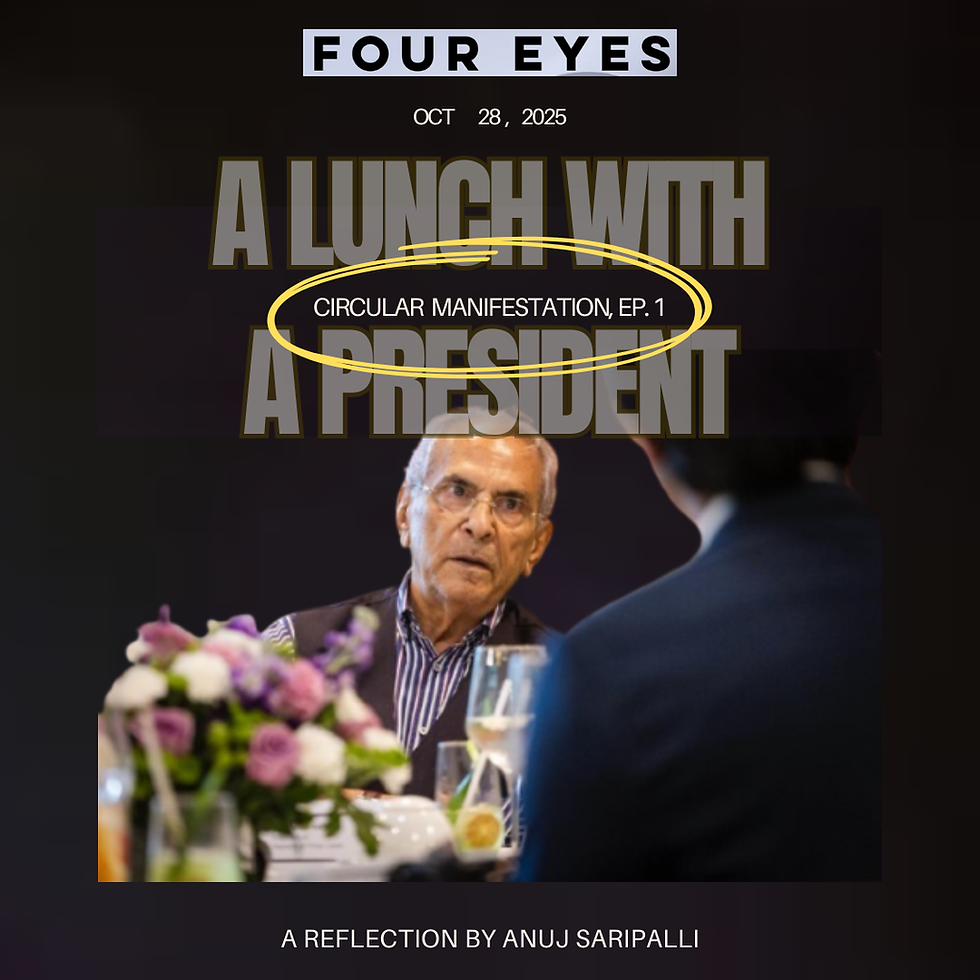
Two years ago, I sent an essay entry to Oxford Royale on climate refugees, centering on the resilient story of a man named Ioane Teitiota. During the intense scramble for research, I also learnt about an inspiring leader who empowered Teitiota’s voice and has been fighting for climate justice for decades. His sense of urgency and purpose shaped his nation’s fight for its place at the table. So, naturally inspired by his story, I dreamt of sitting at a table with him one day. I am talking about Nobel Peace Prize laureate His Excellency Jose Ramos-Horta, President of East Timor.
Cut to the present, it has been nearly two months since I started university at Taylor’s University Malaysia. For those of you unaware, I faced some tough luck regarding scholarship opportunities to study abroad, but Taylor’s offered me a renewed sense of hope with its brand-new PPE programme. (Through this turbulent past year, I am beyond grateful to study the course I’ve wanted to study for the past many years.)

Although we are quite an intimate bunch of students, the opportunities have been endless. (But, as with any place, only if you look hard enough and grab them.) To #MakeIt, as my previous home, KTJ, taught me to embody, whether things appear to go my way or not.
Trusting the process, I got an opportunity of a lifetime: a two-hour lunch with HE Jose Ramos-Horta, who also happens to be an honorary adjunct professor for the PPE programme (how coincidental). The timing was perfect given his country’s long-awaited admission into ASEAN. I was fortunate to sit at the main presidential table along with Ambassador Dato Amarjit Singh, Taylor’s Group Chairman Dato Loy, and Vice Chancellor Barry Winn. My conversations with all of them brought me glimpses into various aspects of life. Their experience and life stories were introspective and probed me to reflect on my future career path. A question I look forward to reflecting on more intentionally in the coming weeks.
Below is a mix of reflections, quotes, and stories.
Stop saying the youth are the future.
Hold on, let me clarify with a loose transcription of what His Excellency opined.
Me: Mr President, what advice would you give to youth like us?
His Excellency: Everyone everywhere I go say that the youth are the future. Can we unpack that statement? Of course, the youth are the future! Logically, they will grow old and be the future. I was young once upon a time, too! (Chuckles) For centuries, people said the youth would change the world. And? It is a good ideal to talk about, but the most realistic thing the youth should do is study hard. Make your parents’ money worth because education will take you a long, long way.

This was refreshing because it was immediately made clear that he was a no-nonsense man with clarity (and experience). Fun fact: About two-thirds of East Timor are young people. It’s obvious that the President does not think young people are unworthy despite the opinion; rather, a stable future is built on an educated present. The emphasis on education reminded me of my grandfather, whose biggest asset for his family was the value of education. Something I hope to pass down in the future, too.
It was long, but necessary.
Me: Congratulations on your country’s admission into ASEAN. It’s been a long journey, hasn’t it? 50 years in the making. How do you feel, and what goals do you have for the future?

His Excellency: Yes, it’s great, but while it was a lifelong dream for me, the wait was necessary. If we were immediately admitted, we wouldn’t have the credibility to secure better economic deals.
I understood his point clearly at his guest lecture later that day, when he reflected on a UN experience decades ago. Despite having a seat at the table, his voice was not empowered. He had even quietly left the meeting, and no one had noticed! For a young country such as Timor-Leste, his priorities, while unconventional, are shaped by his experience. Such conversations really expand one’s worldview.
We need students like you to lead countries.
This was in conversation with Chairman Dato Loy and Vice Chancellor Barry Winn who candidly spoke about the origin story of the PPE programme. They opined that Malaysia needs more changemakers. The President had an interesting take (again):
We need more scientists, not social scientists.

As an advocate for the humanities to be seen as essential and not exotic, I found this opinion surprising, given that it came from a President who had been educated in the Arts himself. Yet, his emphasis on the sciences stems from his goal of nation-building. This is evident in his persistence in joining ASEAN, fighting for climate justice, and eradicating poverty.
And his words walked the talk: earlier this year, in July, the WHO certified Timor-Leste as malaria-free. A remarkable achievement for any nation, especially one that is building itself to allow its people to break free from vicious cycles of poverty.
Sitting at the table beside me was a fellow PPE student, Seemar Brahm, who posed an interesting question:
Seemar: If you were Prime Minister, what executive changes would you make?
His Excellency: I would restructure the ministry in a way that no other country has done. I understand that more importance and space are given to defence or foreign affairs, and while those are valid, they should not be the number one priority for a nation like ours. In my opinion, the Ministry of Education should be at the top. Then, the Ministry of Health. Following these, in third place, I would place the Ministry of Agriculture.

It has been a while since I last blogged consistently, but for those who know me personally, the mention of education and agriculture got me perked up for good reason. Over the past few years, I've read the works of Amartya Sen, drafted policies for Malaysia's first digital school, tutored students and refugees around the world, won an essay competition on the role of EdTech in bridging inequalities, committed to empowering students by designing a new curriculum that incorporated ESD, and presented a policy paper addressing the Malaysian school leaver issue to World Bank, UNDP, and Parliament leaders. On the agriculture front, I explored the interaction between gender inequity in property rights and food security in my EPQ, and briefly ran my own social juice business (Jugo) for a couple of years with a brilliant team whom I miss dearly. There is so much more good work to do, and moments like the lunch reinforce the drive to get better at doing good for society.
Seated next to me was also Ambassador Extraordinary and Plenipotentiary of Malaysia to the Democratic Republic of Timor-Leste, Dato' Amarjit Singh. My favourite part of our conversation can be summed up in two words:
Adaptability and humility. These are fundamental.
Me: If I want to be a diplomat like you, how should I go about it?
Dato Amarjit Singh: Despite majoring in public policy and law, I did not start my career as a diplomat. I somehow found myself working as a journalist, and I learnt a lot. However, those two years working allowed me to improve my English skills. It is the language of the world, whether we like it or not. It allowed me to move up the diplomatic ladder. You need to be flexible and adaptable. I've travelled half the world as a diplomat; it's necessary.

His Excellency: I also think humility is very important. You cannot afford to be arrogant and expect long-term positive change. Being humble allows you to stand your ground while having a voice.
Voice. I thought to myself that no matter the career, I will aim to empower people's voices.

I would like to extend my gratitude to my senior lecturers Dr Deboshree Ghosh, Dr Julia Rocknifard, and Dr Dr Alexey Zhavoronkov, for their continuous efforts to make the inaugural PPE year work so well. There are some more exciting plans in the works, will write again soon.
(Hint: it will be a part of this circular manifestation series. Watch this space.)
All in all, it was an experience I'll cherish and won't stop talking about.
Just got to trust the process.
Disclaimer: The views and reflections expressed in this post are solely my own. All quoted material has been paraphrased or recalled to the best of my ability and may not reproduce the exact wording, but accurately conveys the intended meaning and essence.


Comments